Money Saving Tips for Groceries
Money Saving Tips for Groceries: Cut Your Food Bill in Half
Table of Contents
- Introduction: How Grocery Bills Got Out of Control
- The Grocery Store Is Designed to Take Your Money
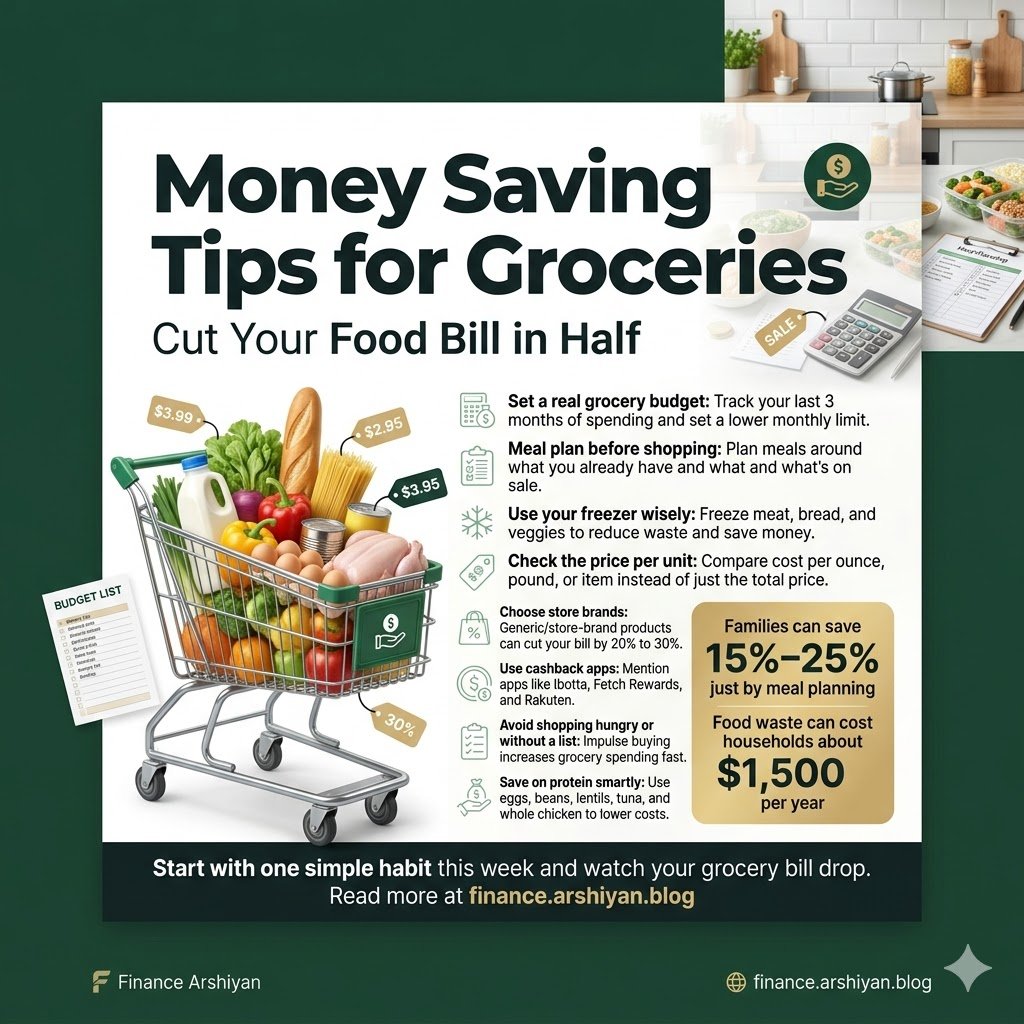
- Step 1: Start With a Real Grocery Budget
- Step 2: Meal Plan Like You Mean It
- Step 3: Use Your Freezer to Prevent Food Waste
- Step 4: Compare Price Per Unit Before Buying
- Step 5: Switch to Store Brands and Save More
- Step 6: Use Cashback Apps for Grocery Savings
- Step 7: Stop Shopping Hungry, Tired, or Without a List
- Step 8: Rethink Protein Without Going Meatless
- The One Mistake That Destroys Grocery Budgets
- Frequently Asked Questions About Saving Money on Groceries
- Final Thought: Build One Money-Saving Grocery Habit at a Time
I still remember standing in the checkout line at Kroger, watching the total climb past $280 for a single week’s groceries. My cart had nothing fancy in it. No steaks, no imported cheese, no organic everything. Just regular food for a family of four in suburban Ohio. I handed over my card and felt that familiar sinking feeling — like I’d just handed someone my wallet and they’d kept it.
That was three years ago. Today, my family spends right around $520 a month on food, and we eat well. We are not clipping coupons like it’s 1987, and we are not eating rice and beans every night either. What changed was a combination of small habits, smarter planning, and finally paying attention to where the money was actually going.
This is not a list of tricks you’ve already read ten times. These are the real things that made a real difference. Read complete Saving Money Guide.
The Grocery Store Is Designed to Take Your Money
Before you can fight back, it helps to understand the battlefield.
Supermarkets spend millions on layout psychology. The essentials like milk, eggs, and bread are always at the back of the store so you have to walk past everything else to reach them. Eye-level shelves are rented out by big brands. The end caps that look like deals? Many of them are not on sale at all — they just look like they are because of the placement and signage.
Knowing this doesn’t make you immune to it, but it does make you a little more skeptical when you feel a sudden urge to grab something that wasn’t on your list.
Step 1: Start With a Real Budget, Not a Vague Intention
Most people who say they want to save on groceries have never actually written down what they spend. They guess, usually low, and then wonder why it keeps going over.
Pull up your bank or credit card statements. Look at the last three months of grocery spending. Add it up. Divide by three. That’s your real number.
Once you know it, pick a target that’s 20 to 25 percent lower. That’s your new monthly grocery budget. Not a wish — a limit with a plan behind it.
If you use a budgeting app, both YNAB (You Need A Budget) and Mint let you create a dedicated grocery category and will alert you when you’re close to the edge. I personally use YNAB, and having that real-time alert on my phone while I’m in the store has stopped a lot of impulse buys cold.
How to Budget on a Low Income Without Losing Your Mind
Step 2: Meal Plan Like You Mean It
I know, I know. Everyone says meal plan. But there’s a difference between scribbling “pasta Tuesday” on a sticky note and actually planning in a way that cuts waste and saves money.
Here’s the process that worked for me:
Sunday evening, before you shop:
- Check what’s already in your fridge, freezer, and pantry. Write it down or take a photo.
- Look at what’s on sale at your local store. Most major chains post their weekly ads online. Kroger, Walmart, Aldi, and Publix all have apps or websites where you can see this before you leave the house.
- Build your meals around what’s on sale and what you already have, not the other way around.
- Write a shopping list organized by store section so you move through the store fast and don’t wander.
This one habit alone saved my family roughly $180 a month when we first started. We were throwing out so much food before because we’d buy things without a plan, then order pizza on Wednesday and let the chicken go bad.
Step 3: The Freezer Is Your Best Financial Tool
Americans waste an estimated $1,500 worth of food per year per household, according to research from the USDA. A huge chunk of that is meat and produce that goes bad before it gets used.
Your freezer is the fix.
When chicken breasts go on sale for $1.79 a pound, buy a lot. Portion them out, label them with a date, and freeze them. Same with ground beef, pork chops, and salmon. Buy on the low, use over the next month or two.
Most fresh vegetables can be blanched and frozen if you’re not going to use them in time. Spinach, broccoli, green beans, corn — all fine in the freezer. Bread goes stale before you finish it? Freeze half the loaf.
A vacuum sealer like the FoodSaver FM2000 runs about $70 at Walmart or Target and pays for itself within a few months if you’re buying in bulk and preserving correctly. Freezer burn is the enemy, and a vacuum sealer eliminates it.
Step 4: Learn the Price Per Unit Game
The big box and the small box do not always work out the way you expect. A 32-ounce jar of pasta sauce might look cheaper than two 16-ounce jars, but sometimes it isn’t. Stores count on you not doing the math.
Every shelf in a grocery store has a small tag that shows the price per ounce, per count, or per pound. Use it. When comparing two similar products, ignore the face price and go straight to the unit price. This works for cereal, canned goods, cleaning products, shampoo — anything where size varies.
At warehouse stores like Costco or Sam’s Club, the per-unit price is almost always lower for non-perishables and shelf-stable items. Olive oil, canned tomatoes, nuts, coffee, and toilet paper are almost always worth buying there if you have the storage space.
Step 5: Store Brands Are Not a Compromise Anymore
There was a time when buying the store brand meant sacrificing quality. That time has largely passed.
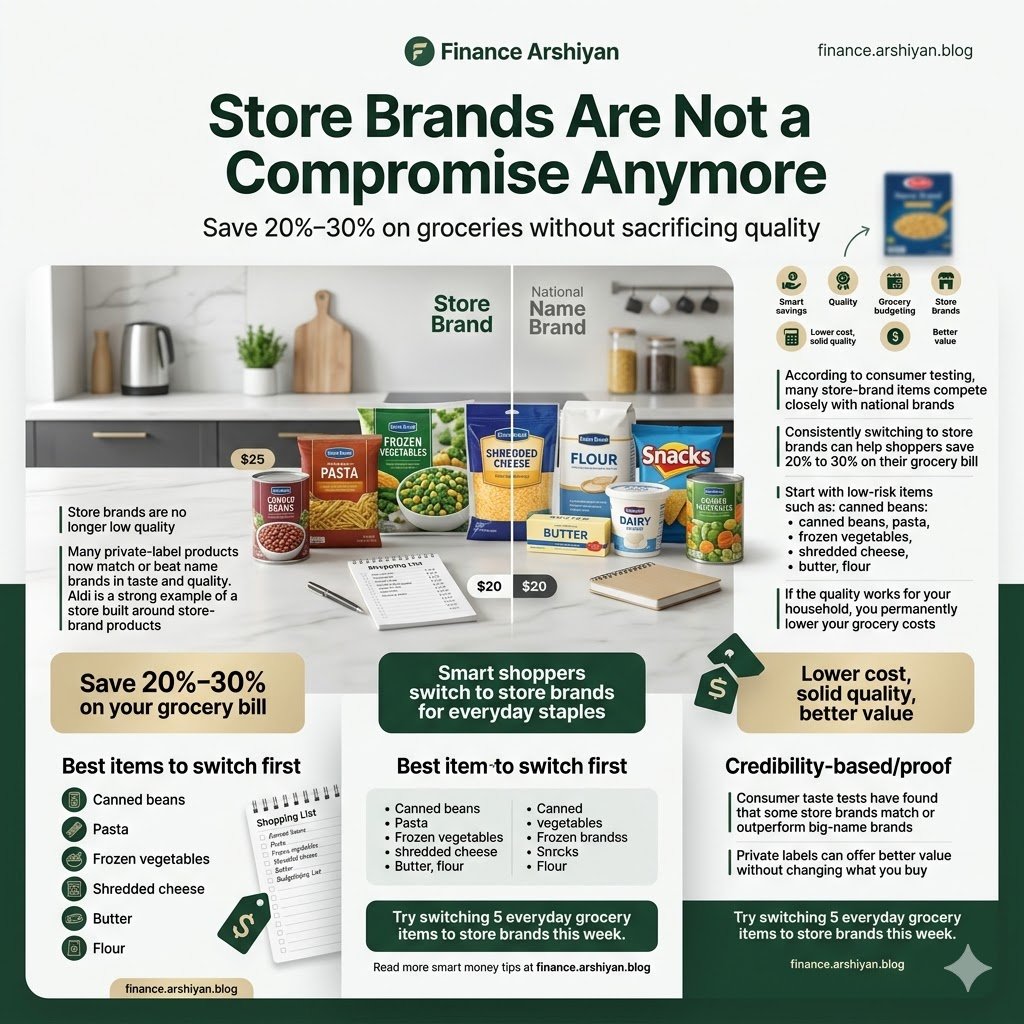
Aldi built an entire business model around this. Nearly everything in the store is their own brand, and the quality on most items is genuinely good. Multiple taste tests by organizations like Consumer Reports have found that Aldi’s products match or beat name brands in categories like canned vegetables, dairy, frozen foods, and snacks.
A study published by the Food Marketing Institute found that shoppers who switched consistently to store brands saved between 20 and 30 percent on their total grocery bill without changing what they bought, only who made it.
Start with low-risk items: canned beans, pasta, frozen vegetables, shredded cheese, butter, and flour. If you like the store brand version, you’ve just permanently lowered that item’s cost in your household.
Step 6: Cashback Apps Are Not Just Coupons in Disguise
Old-school couponing took hours and required a binder. Nobody has time for that. But cashback apps take about five minutes a week and can easily return $20 to $40 a month.
The three worth actually using:
Ibotta — Links to your loyalty card or you scan your receipt. Offers on produce, dairy, meat, and specific products. Payouts via PayPal or Venmo once you hit $20.
Fetch Rewards — Scan any grocery receipt and earn points on almost everything. Good for gift cards, not as strong for cash, but almost zero effort required.
Rakuten — Primarily for online grocery orders through Walmart, Target, or Instacart. If you do any click-and-collect or delivery, Rakuten gives you a percentage back.
I average about $35 a month across these three apps with almost no active effort. That’s $420 a year for scanning receipts I was already keeping.
50 Practical Ways to Cut Monthly Expenses Without Feeling Deprived
Step 7: Stop Shopping Hungry, Tired, or Without a List
This sounds too simple to matter, but the research behind it is solid. A study out of Cornell University found that people who shopped hungry bought significantly more high-calorie, impulse-purchase items than those who shopped after eating.
Shopping tired produces similar results. Your decision-making weakens, and you default to whatever’s convenient and familiar rather than what’s on your list.
The fix is boring but it works: eat before you go, bring a specific list, and set a time limit. Tell yourself you’re in and out in 30 minutes. That urgency keeps you on task.
Also, shop alone when possible. Kids in the cart, as beloved as they are, cost money. Multiple studies have confirmed that shoppers spend more when accompanied by others, especially children.
Step 8: Rethink Protein Without Going Meatless
Protein tends to be the most expensive part of any grocery cart. Beef and seafood especially. You don’t need to become a vegetarian to save money here, but stretching your protein budget means being flexible.
Eggs are one of the best deals in the entire store. A dozen large eggs at around $3 to $4 (even post-inflation) gives you 12 high-quality protein servings. Canned tuna, canned salmon, and sardines are similarly efficient. Dry lentils and dried beans cost almost nothing per serving and are genuinely filling.
When you do buy meat, whole cuts are almost always cheaper than pre-cut or pre-packaged options. A whole chicken at $1.29 per pound beats pre-cut thighs at $2.89 per pound. If butchering a chicken sounds intimidating, there are plenty of five-minute YouTube tutorials that walk you through it. After the second time, it takes about four minutes.
The One Mistake That Kills Most Grocery Budgets
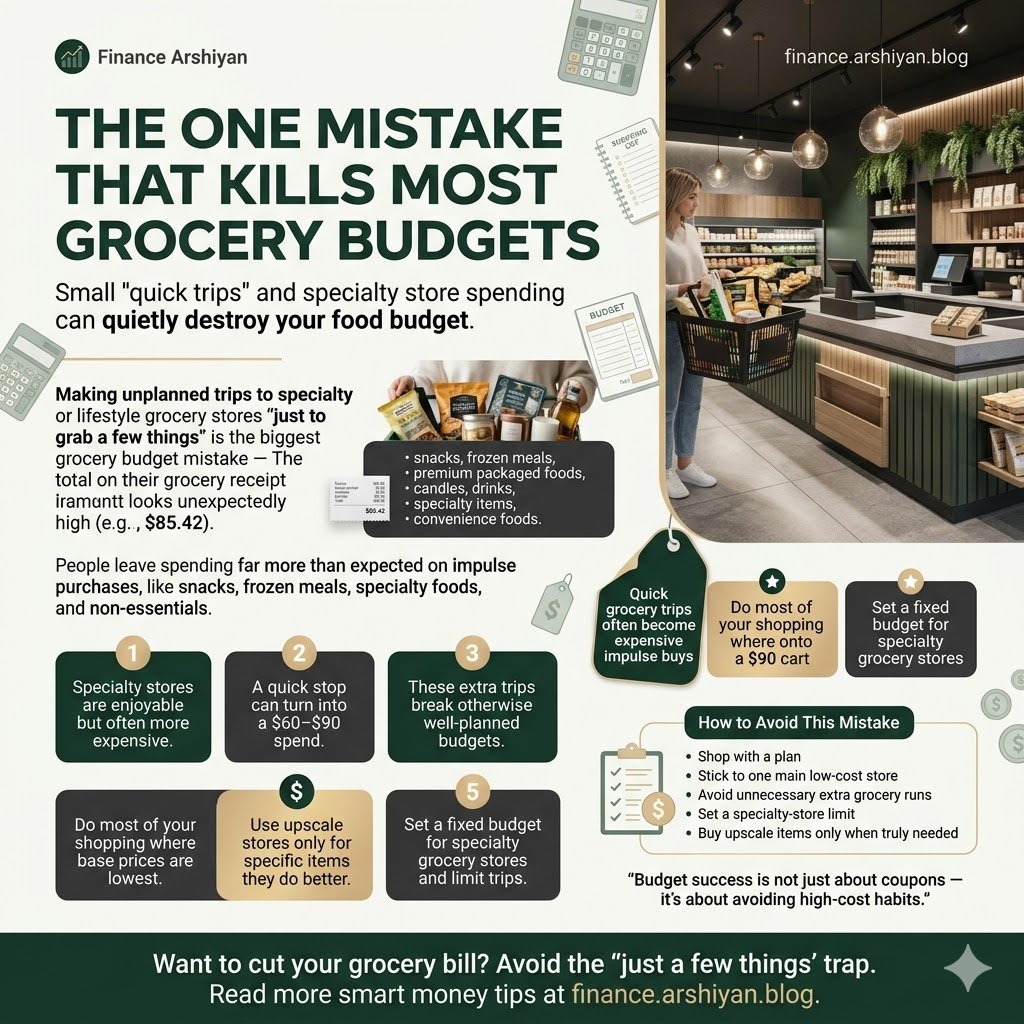
People do all the right things — they plan, they use apps, they shop sales — and then they make one trip to Trader Joe’s “just to grab a few specialty things” and spend $90 on snacks, frozen meals, and a candle that somehow ended up in the cart.
Specialty and lifestyle grocery stores are wonderful. They are also expensive, and they are excellent at making you feel like every item is a reasonable treat. Set a fixed budget for those stores if you visit them, or limit trips to once a month.
The bulk of your shopping should happen at the store with the lowest base prices for your area. For most Americans, that’s Aldi, Walmart, Lidl, or a local discount chain. Save the upscale stores for the specific items they genuinely do better.
Financial Mistakes to Avoid in Your 20s and 30s
Frequently Asked Questions
Q: How much should a family of four realistically spend on groceries per month?
A: The USDA publishes monthly food cost reports based on a “moderate” plan, which as of recent data puts a family of four at roughly $975 to $1,100 per month. A thrifty plan sits around $700 to $750. With smart shopping habits, many families comfortably land between $550 and $700 without feeling deprived.
Q: Is it worth driving to multiple stores to save money?
A: Sometimes, but not always. If the stores are close together, splitting your trip between Aldi for most items and a larger store for specific items you can’t find there can save $40 to $60 a month. If it means driving 20 extra miles each week, the gas cost and time usually cancel out the savings. Be realistic about what your time is worth.
Q: Does buying in bulk always save money?
A: Not always. Bulk buying only saves money when you actually use what you buy before it expires or goes stale. For shelf-stable items like rice, pasta, canned goods, coffee, and cleaning supplies, bulk is almost always worth it. For fresh produce and dairy, be more cautious unless you have a solid plan to use it or can freeze the excess.
Q: What’s the single most impactful change someone can make right now?
A: Start a weekly meal plan and stop making unplanned mid-week grocery runs. Those quick stops are where budgets bleed out. Most people find this one change alone reduces their grocery bill by 15 to 20 percent within the first month.
Q: Are grocery delivery services like Instacart worth it if I’m trying to save money?
A: It depends on your habits. Delivery fees and markups add cost, but some people find they actually spend less because they’re not walking the aisles and picking up extras. If impulse buying is your biggest problem, the structure of an online cart might be worth the delivery fee. If you’re disciplined in stores, shop in person.
Q: How do I get my family on board with cutting the grocery budget?
A: Frame it as a game rather than a punishment. Set a monthly savings goal, track progress visibly, and redirect the savings toward something the family cares about — a vacation, a new experience, or paying off a debt faster. When people see the savings building toward something real, the motivation tends to stick.
A Final Thought
Cutting your grocery bill in half is not about suffering through boring meals or spending your Saturdays clipping coupons. It’s about closing the gap between what you buy and what you actually use, learning the tricks stores use to part you from your money, and building habits that eventually run on autopilot.
The families who do this well are not extreme couponers. They’re just people who decided to pay attention. After a few months of tracking, planning, and adjusting, the habits become second nature, and the savings show up every single month whether you think about them or not.
Try our free tool:
Savings Goal Calculator
Start with one change this week. Pick the one that feels most manageable. A single good habit, built and held, beats a perfect system you never actually use.

My name is Arshiyan Ahmed, and I write about personal finance because I’ve lived through the stress of financial uncertainty — and found my way out of it.
Over the past 7+ years, I’ve spent hundreds of hours studying budgeting systems, debt payoff strategies, and savings frameworks — not just in theory, but by applying them to real life. I’ve personally used the debt snowball method to eliminate credit card debt, built a 6-month emergency fund on a modest income, and helped friends and family create their first workable budgets.
I started Arshiyan Finance because I noticed one thing: most financial content online is either too complicated for beginners or too generic to be useful. I wanted to build a space where everyday people — whether you’re living paycheck to paycheck or just looking to manage money smarter — could find clear, actionable, and honest financial guidance without being sold something.
Everything I publish here is based on widely accepted financial principles, researched thoroughly, and written in plain language anyone can follow. The calculators, guides, and strategies on this site are the same tools I use and recommend to people I care about.
I’m not a licensed financial advisor, and nothing on this site is professional financial advice — but I do believe that access to good financial education can change lives. That’s why everything here is completely free.
When I’m not writing about money, I’m reading about it — because the more I learn, the better I can explain it to you.
Have a question or topic you’d like me to cover?