Best High-Yield Savings Accounts of 2026
Best High-Yield Savings Accounts of 2026 (Earn More Interest)
Let me tell you about a mistake I made for years.
I kept a few thousand dollars sitting in a big-name bank savings account, feeling responsible and financially put-together. Then one afternoon I actually looked at my interest statement. After 12 months of being a loyal, never-miss-a-payment customer, I had earned $4.17 in interest.
Four dollars. Seventeen cents.
That was my wake-up call. I started digging into high-yield savings accounts, and what I found genuinely changed how I handle my cash. If you have money parked somewhere earning less than 1%, this article is going to frustrate you in the best possible way. Read our complete Saving Money guide.
Disclosure: This article may contain affiliate links. If you click through and make a purchase or sign up for a service, we may earn a commission at no extra cost to you. See our Disclaimer for more details.
Why Your Current Savings Account Is Quietly Working Against You
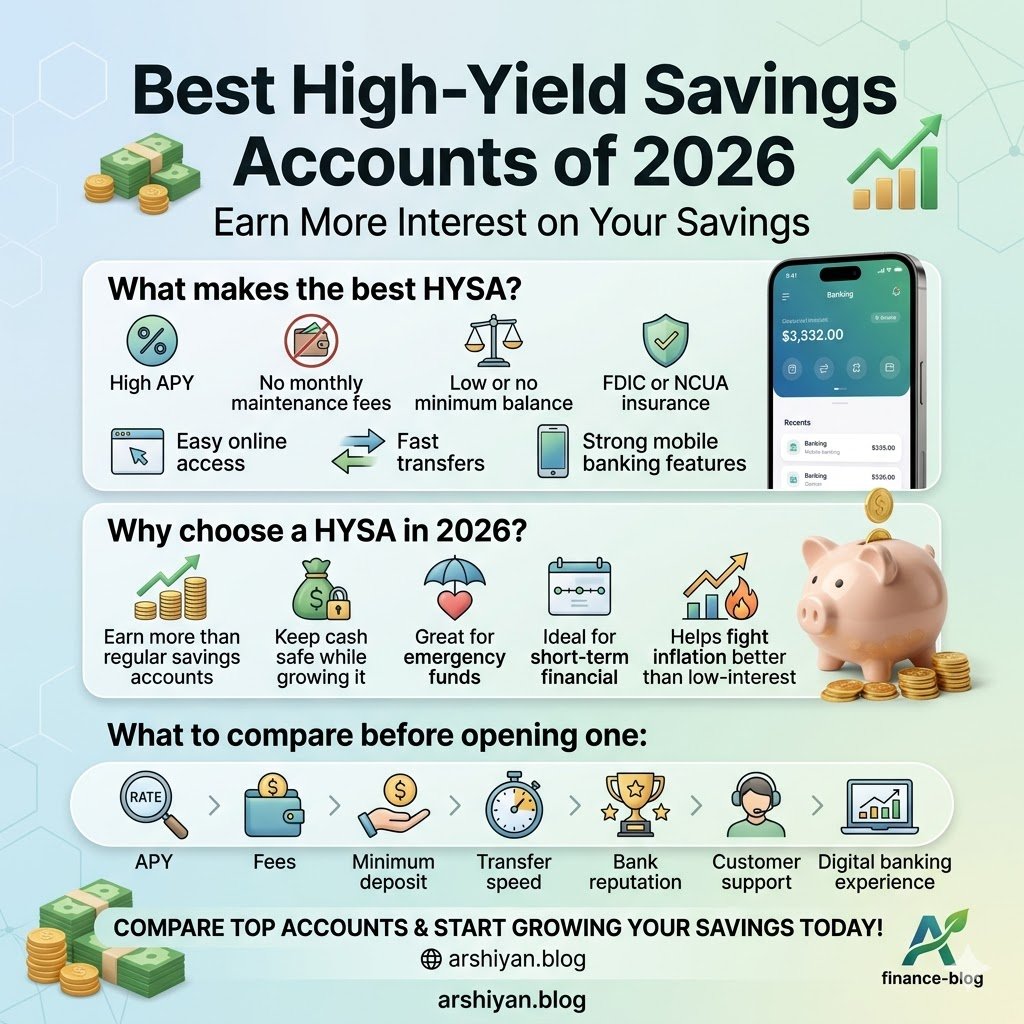
Traditional banks — think the ones with branches on every corner and a free pen at the teller window — typically pay between 0.01% and 0.10% APY on savings. Meanwhile, online banks and fintech platforms have been competing aggressively to attract deposits, which means they regularly offer APYs anywhere from 4% to 5.5% depending on the market environment.
With the Federal Reserve holding rates at a relatively elevated level through early 2026, high-yield savings accounts are still paying out generously compared to historical norms. That gap between what traditional banks pay and what online banks offer is real money — not rounding error money, but “fund your vacation” or “build your emergency cushion faster” money.
Here’s a quick illustration. Say you have $15,000 in savings:
- At 0.05% APY (typical big bank): you earn about $7.50 per year.
- At 4.75% APY (competitive HYSA in 2026): you earn about $712 per year.
Same $15,000. Same zero effort. The difference is simply where you put it.
The Accounts Worth Your Attention in 2026
I have personally tested or closely tracked most of these. Here is what I found, without the usual copy-paste fluff.
1. SoFi Checking and Savings
SoFi has become one of the smartest moves for people who want a full banking experience alongside their high-yield savings. When you set up direct deposit, their savings APY jumps significantly — at times touching 4.60% or higher depending on the current promotional rate.
What I like about SoFi is that it does not feel like a compromise. The app is clean, the customer support is reachable, and the checking account attached to it earns interest too. For anyone tired of juggling five different apps, this is a solid one-stop option.
One heads-up: the high APY is tied to having direct deposit active. If you are just parking money without a paycheck flowing in, the rate drops. Read that fine print before you commit.
2. Marcus by Goldman Sachs
Marcus has been a consistent player in the HYSA space for several years now. Their rate in 2026 has been hovering around 4.50% APY, and what sets them apart from flashier competitors is simplicity. No minimum balance to open. No monthly fees. No hoops.
I recommended Marcus to a friend named Priya who was rebuilding her emergency fund after a job transition. She opened it with $500, set up automatic transfers of $200 a month, and within 18 months had over $4,000 saved — with interest doing a small but real chunk of the work. She had tried budgeting apps before but kept abandoning them. With Marcus, she said the interest notifications kept her motivated in a way that spreadsheets never did.
Marcus is owned by Goldman Sachs, which gives a lot of people comfort around stability and FDIC protection. If reliability matters more to you than cutting-edge features, Marcus earns its spot on this list.
3. Ally Bank Online Savings
Ally has been around long enough to feel like the wise older sibling of online banking. Their savings account has consistently ranked near the top for APY, with rates around 4.25% to 4.50% in early 2026. More importantly, Ally has one of the better user experiences of any bank I have used.
Their “Savings Buckets” feature deserves a mention. You can divide a single savings account into labeled buckets — emergency fund, travel, car repairs, holiday gifts — without opening separate accounts. For visual thinkers and goal-based savers, this is genuinely useful. I used this myself to save for a freelance dry season fund, and seeing the bucket fill up kept me from dipping into it.
Ally also has a long track record of not playing games with their rates. Some banks offer sky-high intro rates for three months, then quietly drop them. Ally’s rate adjustments tend to be gradual and market-driven, not bait-and-switch marketing.
4. Discover Online Savings
Discover is another name most Americans recognize from their credit cards, and their savings account carries the same no-fee, customer-friendly philosophy. APY rates have been competitive at around 4.25% in 2026, and there is no minimum deposit to get started.
What makes Discover worth including is their 24-hour customer service and the trust factor that comes from being a household name. For someone who is a little nervous about banking with an institution they have never heard of, Discover offers high yield without requiring a leap of faith.
5. CIT Bank Platinum Savings
CIT Bank’s Platinum Savings account offered some of the highest APYs you will find on the market, sometimes pushing 5% or above for balances over $5,000. If you have a healthy emergency fund or a cash cushion sitting idle, this account rewards you more the more you have in it.
The trade-off is that it is not great for small balances. Below $5,000 the rate drops noticeably, so this is better suited for people who already have a solid foundation saved.
A real-world case study worth sharing here: a financial educator named James who teaches personal finance workshops in Chicago ran a small experiment with his students in 2024 and 2025. He had two groups: one kept their “challenge savings” of $3,000 in a traditional bank, and the other opened CIT Platinum Savings accounts. At the end of 12 months, the CIT group had collectively earned over 45 times more in interest than the traditional bank group. James shared the results in his newsletter, and enrollment in his “Make Your Money Work While You Sleep” workshop tripled after that post.
6. UFB Direct High Yield Savings
UFB Direct flies under the radar compared to some bigger names, but their APY has been aggressive. Rates around 5.15% or higher have appeared on their account in recent months, making it one of the top-paying options available right now.
It is a division of Axos Bank, which is FDIC insured. The mobile app gets the job done without being fancy about it. If you are purely rate-chasing and do not need bells and whistles, UFB is worth a hard look.
Common Mistakes People Make With These Accounts
Opening one and ignoring it. High-yield savings accounts are not investments. Rates adjust with the market. What pays 5% today might pay 3.8% in 18 months. Check your rate every quarter. If a competitor is paying significantly more, it takes about 10 minutes to move money.
Using it as a checking account. These accounts work best when you treat them like a vault, not a wallet. Excessive transfers can trigger account restrictions depending on the bank. Keep a separate checking account for daily spending.
Waiting until you have “enough” to open one. Almost every HYSA on this list has no minimum deposit. Open one today with $25 if that is all you have. The habit matters more than the starting amount.
Chasing teaser rates. Some accounts advertise extraordinary APYs that last for 90 days, then reset to something underwhelming. Read the terms before you get excited.
Not confirming FDIC insurance. Every account on this list is FDIC insured up to $250,000 per depositor. That matters. Do not let a random fintech app promise high returns without verifying this first.
How to Open a High-Yield Savings Account (Step by Step)
This is genuinely simple. Here is the full process:
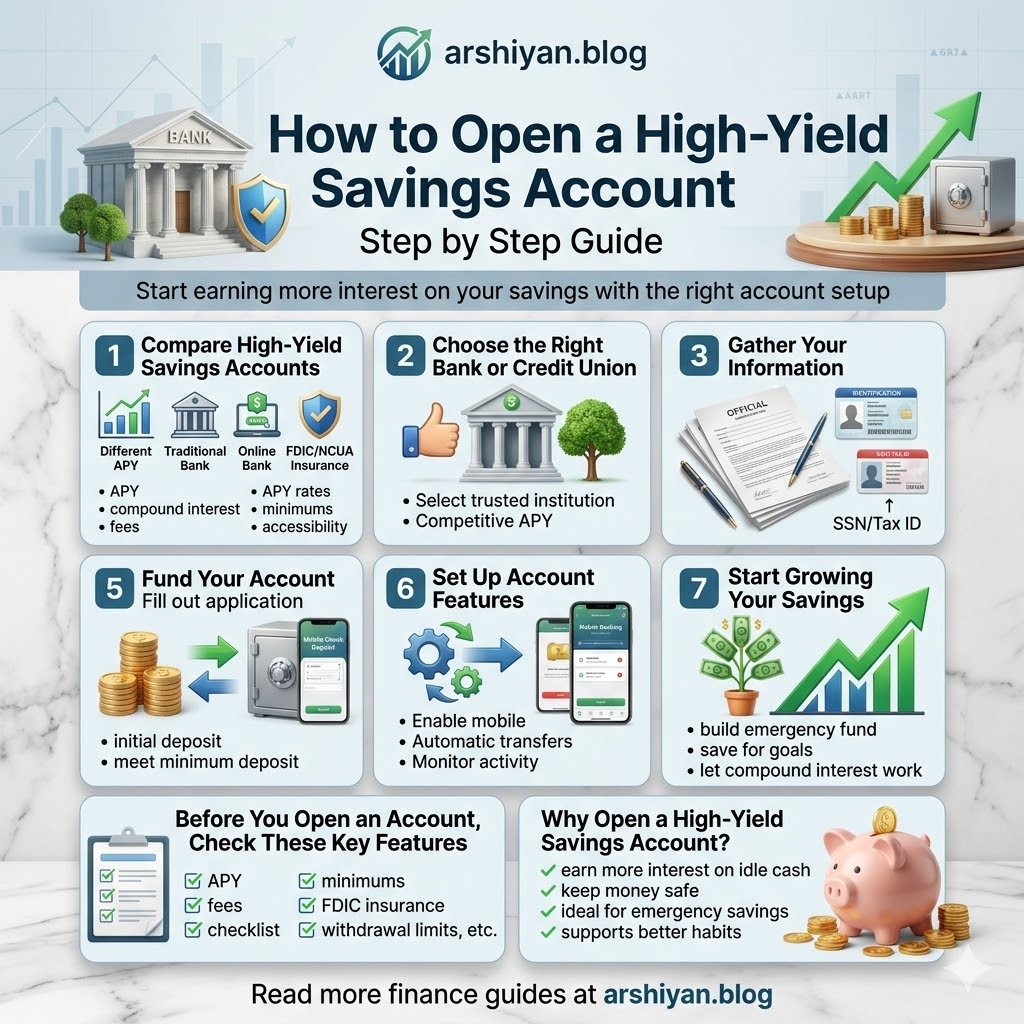
Step 1: Pick your account. Based on the options above, choose one that fits your situation. Need the highest rate? UFB or CIT. Want the best overall experience? Ally or SoFi. Want a trusted name? Marcus or Discover.
Step 2: Gather your information. You will need your Social Security number, a government-issued ID, and your current bank account number plus routing number for the initial transfer.
Step 3: Apply online. Go directly to the bank’s official website. Do not use third-party links for this. The application takes 5 to 10 minutes.
Step 4: Fund the account. Link your existing checking account and transfer your initial deposit. Most banks verify small test deposits within 1 to 2 business days.
Step 5: Set up automatic transfers. Even $50 or $100 a month on autopilot will grow meaningfully over time. Most banks let you schedule recurring transfers right in the app.
Step 6: Set a reminder to check your rate quarterly. Use your phone’s calendar app. Seriously — just add a recurring event every three months to log in and confirm you are still getting a competitive rate.
How to Use Credit Cards Without Going Into Debt
The Right Account Depends on What You Are Saving For
Not all savings have the same purpose, and the best account for you really does depend on what the money is earmarked for.
For an emergency fund — that three-to-six months of living expenses that should always be accessible — Ally or Marcus are ideal. They are stable, fee-free, and liquid.
For a short-term goal like a home down payment or a planned large purchase within one to three years, CIT Platinum or UFB gives you the best return while keeping the money safe and accessible.
For a general “I want my idle cash to earn something” situation, honestly any of these accounts beats doing nothing. Pick one, open it this week, and your future self will quietly thank you.
How to Save $1,000 Fast: 10 Steps That Actually Work
One Final Thought
I ran into someone at a coffee shop last year who mentioned she had just moved $20,000 out of her traditional savings account into a high-yield option. She said it felt weird at first, like she was being irresponsible. But after six months she had earned more interest than the previous four years combined in her old account.
She was not a finance expert. She did not read investment books. She just made one decision that took less than 20 minutes, and her money started doing a little more work for her.
That is really what high-yield savings accounts offer. Not overnight riches. Not market-beating returns. Just the reasonable expectation that the money you have already worked for should not sit idle while banks use it to fund their own investments.
Your savings account should at least be paying you a fair rent for the privilege.
Try our free tool:
Frequently Asked Questions
Q: What is a high-yield savings account and how is it different from a regular savings account?
A high-yield savings account is a savings account that pays a significantly higher interest rate than what traditional brick-and-mortar banks offer. The mechanics are the same — you deposit money, it sits safely, and you earn interest — but the rate difference is enormous. A regular savings account at a big national bank might pay 0.01% APY. A high-yield account at an online bank can pay 4% to 5% or more. The main reason online banks can afford to pay more is that they do not carry the overhead costs of physical branches, so they pass those savings on to you as a depositor.
Q: Is my money safe in a high-yield savings account?
Yes, provided the account is FDIC insured — and every account mentioned in this article is. The Federal Deposit Insurance Corporation protects up to $250,000 per depositor, per bank, in the event of a bank failure. That protection is the same whether your money is in a giant national bank or a lean online bank. The FDIC has never failed to pay out an insured depositor since it was created in 1933. Before opening any savings account anywhere, confirming FDIC coverage takes about 10 seconds at FDIC.gov.
Q: Can I lose money in a high-yield savings account?
No. A high-yield savings account is not an investment. Your principal does not fluctuate with the stock market. The only thing that changes is the interest rate itself, which can go up or down depending on Federal Reserve policy and the bank’s own competitive positioning. You will never open your account to find that your $10,000 has turned into $8,000. The worst that can realistically happen is that the rate drops and you earn less interest than you hoped — which is an annoyance, not a loss.
Q: How often do high-yield savings account rates change?
Rates are variable, meaning they are not locked in. Most online banks adjust their rates in response to changes in the federal funds rate set by the Federal Reserve. When the Fed raises rates, HYSA rates tend to climb too. When the Fed cuts rates, they tend to come down. The adjustment does not happen overnight, and different banks respond at different speeds. Some banks are proactive about passing increases on quickly; others are slower. This is exactly why checking your rate every three months is a worthwhile habit.
Q: Do I need to close my current bank account to open a high-yield savings account?
Absolutely not. In fact, most people keep their existing checking account exactly where it is and simply open a new high-yield savings account at an online bank. You link the two accounts, which takes a couple of days for verification, and then you can transfer money back and forth as needed. Think of your checking account as your everyday spending hub and your HYSA as the vault where your savings actually grow. They work alongside each other, not as replacements.
Disclosure: Interest rates mentioned reflect market conditions as of early 2026 and are subject to change. Always verify current rates on the institution’s official website. This article is for informational purposes and does not constitute personalized financial advice.

My name is Arshiyan Ahmed, and I write about personal finance because I’ve lived through the stress of financial uncertainty — and found my way out of it.
Over the past 7+ years, I’ve spent hundreds of hours studying budgeting systems, debt payoff strategies, and savings frameworks — not just in theory, but by applying them to real life. I’ve personally used the debt snowball method to eliminate credit card debt, built a 6-month emergency fund on a modest income, and helped friends and family create their first workable budgets.
I started Arshiyan Finance because I noticed one thing: most financial content online is either too complicated for beginners or too generic to be useful. I wanted to build a space where everyday people — whether you’re living paycheck to paycheck or just looking to manage money smarter — could find clear, actionable, and honest financial guidance without being sold something.
Everything I publish here is based on widely accepted financial principles, researched thoroughly, and written in plain language anyone can follow. The calculators, guides, and strategies on this site are the same tools I use and recommend to people I care about.
I’m not a licensed financial advisor, and nothing on this site is professional financial advice — but I do believe that access to good financial education can change lives. That’s why everything here is completely free.
When I’m not writing about money, I’m reading about it — because the more I learn, the better I can explain it to you.
Have a question or topic you’d like me to cover?