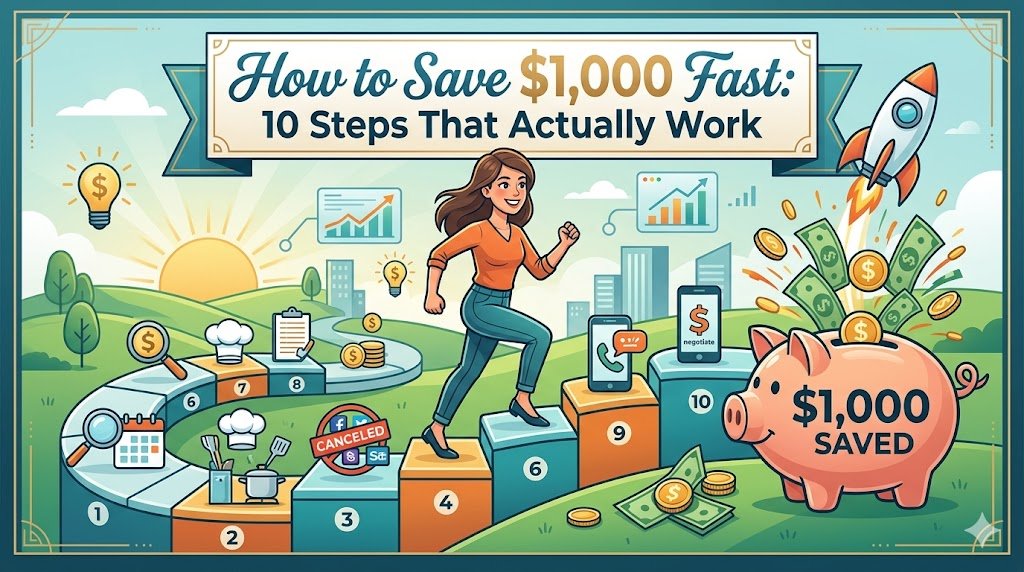
How to Save $1,000 Fast: 10 Steps That Actually Work
How to Save $1,000 Fast: 10 Steps That Actually Work
Let me be upfront with you. I have been broke before. Not “tight budget” broke — I mean eating cereal for dinner and avoiding phone calls from unknown numbers broke. So when I tell you that saving $1,000 faster than you think is possible, I am not reciting something I read in a textbook. I lived it. And I watched several people close to me do the same thing, some in as little as five weeks.
The problem with most saving advice is that it is written by people who have never actually had to scrape money together under pressure. They will tell you to “cut your daily latte” as if that is going to change your life. It will not. What actually moves the needle is a combination of mindset shifts, small behavioral changes, and a few surprisingly powerful tools that most people ignore. Read our complete Saving Money guide.
Here is what genuinely works.
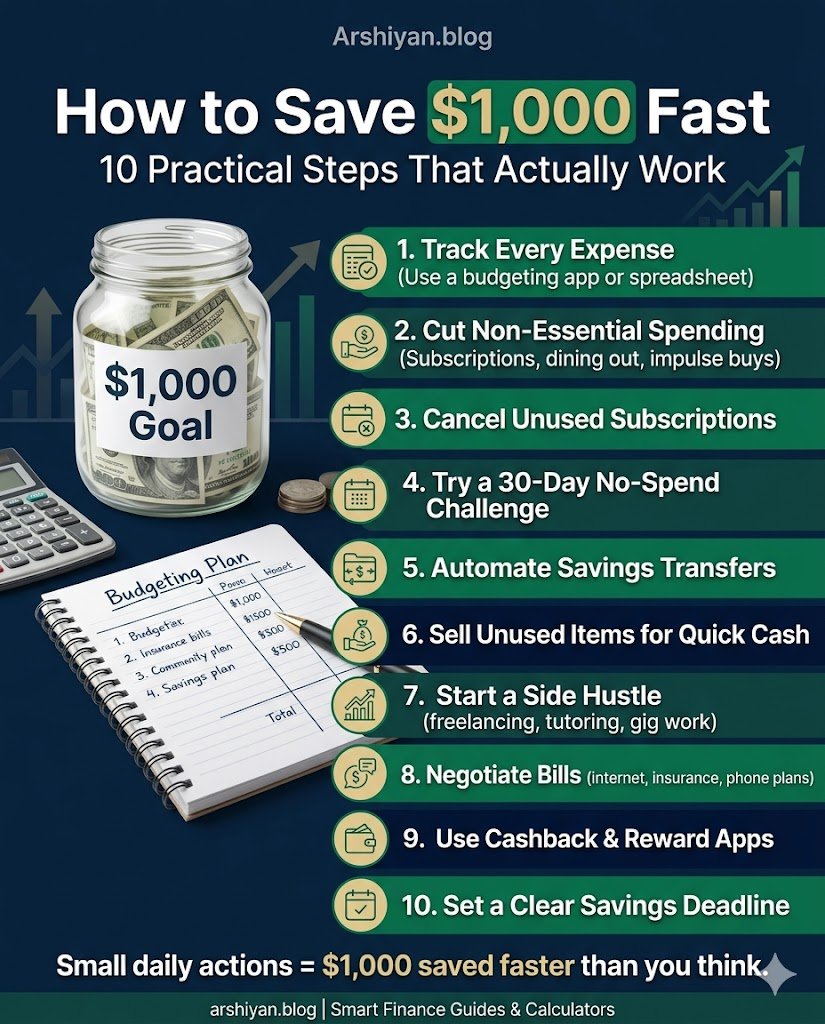
Step 1: Know Exactly Where Your Money Is Going Right Now
Before you save a single dollar, you need a clear picture. Most people are genuinely shocked when they do this exercise for the first time.
Download your last 30 days of bank and credit card statements. Go through every transaction line by line — not in your head, on paper or in a spreadsheet. Categorize everything: groceries, dining out, subscriptions, gas, entertainment, impulse purchases.
When my friend Marcus did this back in 2021, he discovered he was spending $340 a month on food delivery apps — mostly DoorDash and Uber Eats — and had completely lost track of it. He also had three forgotten subscriptions charging him a combined $47 a month. That is nearly $400 sitting in plain sight that he had been blind to.
Apps like Rocket Money (formerly Truebill) or YNAB (You Need A Budget) can do a lot of this work for you automatically. Rocket Money, in particular, is excellent at sniffing out forgotten subscriptions and even negotiating some of your bills down on your behalf.
The goal of this step is not to feel guilty. It is to get clarity. You cannot fix what you cannot see.
Step 2: Set a Realistic but Aggressive Timeline
“Save $1,000 fast” means different things to different people. If you earn $60,000 a year, your path looks different than someone earning $32,000. Be honest with yourself.
For most Americans earning a moderate income, a 6 to 10 week timeline is very achievable. If you are willing to combine savings with some extra income (more on that later), you can get there in 30 days.
Write your goal down physically. Not typed — written. There is a strange psychological stickiness that comes from physically writing a financial goal. Put it somewhere you will see it every morning. Your bathroom mirror. Your phone wallpaper. Make it real.
Then reverse engineer it. If you want $1,000 in 8 weeks, that is $125 per week, or roughly $18 per day. Does that feel more manageable? For most people, yes. Breaking a big number into its daily equivalent removes the paralysis. Try this budget on low income.
Step 3: Open a Separate Savings Account and Make It Slightly Inconvenient
Here is a trick that sounds too simple but is genuinely powerful: do not keep your savings in the same account as your spending money.
Open a free high-yield savings account somewhere like Marcus by Goldman Sachs, Ally Bank, or SoFi. These accounts currently offer APYs that are dramatically better than the near-zero rates at big banks like Chase or Bank of America. While the interest will not make you rich in the short term, the separation itself is the point.
When your savings are in the same account as your spending money, your brain does not treat them as separate. Money is money. But when it lives in a different account, especially one that takes a day to transfer funds from, you are much less likely to dip into it on impulse.
Set up an automatic transfer for every payday — even if it is just $50 to start. Automation removes the willpower requirement entirely, and willpower is a depletable resource. Complete Guide to Credit Scores and How to Improve Yours.
Step 4: Attack Your Biggest Expense First, Not Your Smallest
Personal finance culture loves to talk about skipping coffee. It is the world’s most overused example. But your $5 coffee is not the problem. Your $1,200 rent, $450 car payment, or $280 monthly grocery bill — those are where real money hides.
Look at your three largest spending categories and ask yourself one hard question about each: is there any version of this that costs less right now?
Maybe you cannot move apartments this month, but can you temporarily park your car and use public transit for 30 days? Can you shop at Aldi or Lidl instead of Whole Foods for one month? Can you do a “pantry clean-out week” and spend almost nothing on groceries by eating what you already have?
One couple I know — both working in healthcare in Ohio — saved $800 in a single month just by switching grocery stores and meal prepping on Sundays. They did not eat worse. They just got intentional about it.
Step 5: Run a 30-Day Subscription Audit
Subscriptions are the financial equivalent of a slow leak in a tire. Individually small, collectively catastrophic.
The average American household spends between $200 and $300 per month on subscriptions, according to data from C+R Research. That includes streaming services, gym memberships, software apps, meal kit deliveries, premium news sites, cloud storage upgrades, and more.
Go through every single one. Ask yourself three questions: Have I used this in the last 30 days? Would I notice if it was gone tomorrow? Is there a free alternative?
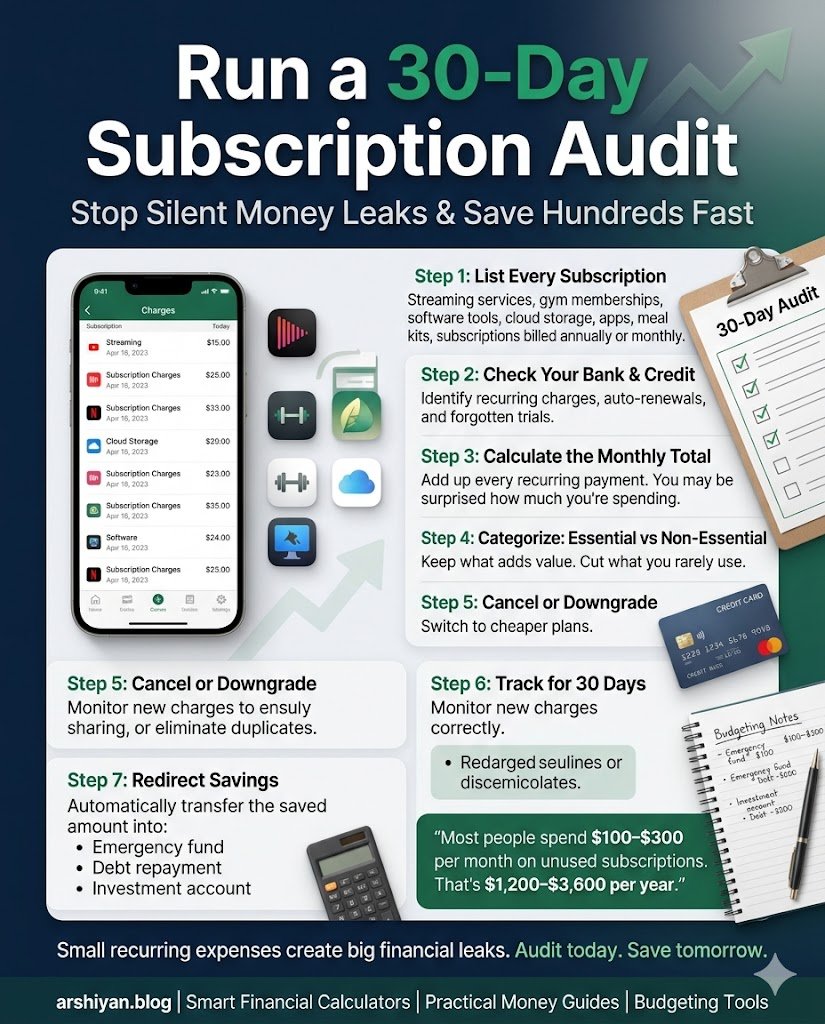
Cancel everything that does not pass that test. You can always resubscribe later. Right now, every dollar matters.
For streaming, most households can comfortably live with one or two services on rotation — watch everything you want on Netflix for two months, then cancel and switch to Hulu, then HBO Max. You never run out of content and your bill stays low. Try this How to Audit Your Monthly Subscriptions and Stop Wasting Money.
Step 6: Sell the Stuff That Is Sitting Around Doing Nothing
I am genuinely convinced that most American homes contain at least $200 to $500 worth of sellable items collecting dust. Old electronics, clothes with tags still on, furniture, sports equipment, kitchen gadgets used twice, baby gear, tools.
Facebook Marketplace is probably the fastest way to turn physical items into cash. It is hyperlocal, free to list, and transactions often happen within 24 to 48 hours. OfferUp is also strong for this. For higher-end electronics, Swappa gets you better prices than eBay with less hassle.
My neighbor sold an old PlayStation 4, some textbooks, a standing desk she no longer used, and a pile of name-brand clothes on Facebook Marketplace over two weekends and cleared just over $430. That was real money that went directly into her savings account.
Set aside a Saturday afternoon, walk through your home room by room, and be ruthless. If you have not touched it in a year, it is a candidate.
Step 7: Add at Least One Income Stream, Even Temporarily
Cutting expenses alone will only take you so far. If you want to hit $1,000 fast, the other side of that equation is earning more — even temporarily.
You do not need to build a business. You just need a few extra hundred dollars over the next few weeks. Some legitimate, low-barrier options:
Instacart or DoorDash — You can sign up and start delivering within a few days in most cities. Many drivers earn $15 to $25 per hour depending on location and time of day.
TaskRabbit — If you are handy or physically capable of helping people move furniture, assemble IKEA products, or do yard work, TaskRabbit connects you with local gigs that pay well.
Rover or Wag — If you like animals, pet sitting and dog walking can bring in surprisingly solid income on weekends without committing to a schedule.
Freelancing your skills — Can you write, design, code, edit video, do bookkeeping, or speak another language? Platforms like Fiverr or Upwork let you monetize a skill you already have.
One clear case study worth mentioning: a 2023 report from Bankrate found that among Americans who took on side gigs that year, the median monthly earnings from those gigs were around $810. That is almost your entire goal right there from a single additional stream.
Step 8: Use Cash Back Tools You Are Already Ignoring
If you are shopping online and not using Rakuten (formerly Ebates), you are simply leaving money on the table. Rakuten gives you cash back on purchases at thousands of retailers — Amazon, Target, Walmart, Macy’s, and hundreds more — just by clicking through their site or browser extension first.
Combined with a cash back credit card (paid off in full every month — this is critical), you can realistically earn $20 to $50 back per month just from regular spending.
Ibotta is excellent for grocery cash back. Honey auto-applies coupon codes at checkout. These tools do not require you to change your lifestyle at all — they just reward the purchases you were going to make anyway.
This will not single-handedly save you $1,000, but it adds real dollars to the pile with zero extra effort.
Step 9: Pause, Do Not Cancel, Your Social Life
Here is a mistake I see people make when they get serious about saving: they go full monk mode, cut out everything fun, and burn out within two weeks. Then they overcorrect and spend more than they would have if they had just been reasonable.
You do not need to stop living. You need to change how you live temporarily.
Eat before you go out so you are not starving at a restaurant. Suggest potluck dinners with friends instead of going out. Look for free events in your city — most cities have free concerts, farmers markets, park events, and museum free days throughout the year. Choose the hike over the movie theater.
The goal is to make saving feel sustainable, not like a punishment. If it feels like a punishment, you will quit.
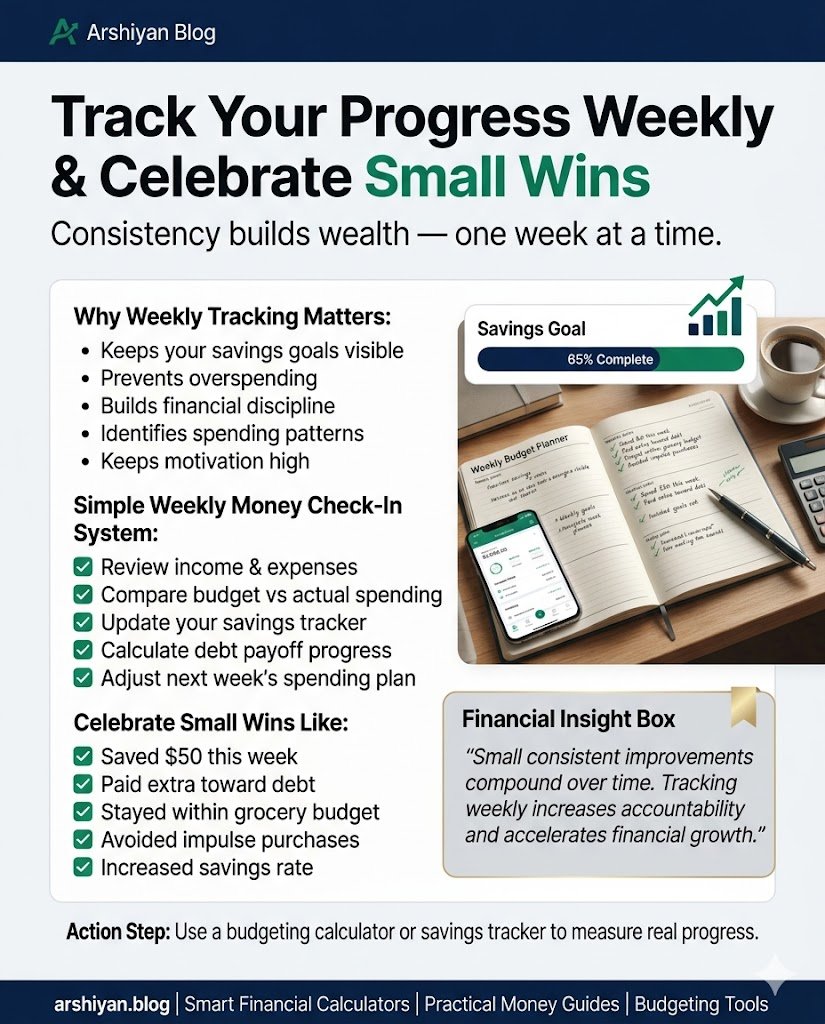
Step 10: Track Your Progress Weekly and Celebrate Small Wins
The final and most underrated step is visibility.
Every Sunday, check your savings balance. Write it down. Compare it to last week. Even if you only added $60, that is $60 more than you had. Acknowledge it. The brain responds powerfully to visible progress — it is the same reason progress bars on websites keep you engaged.
Some people create a simple paper chart and color it in as the number grows toward $1,000. Sounds cheesy. Works brilliantly.
Celebrate milestones without spending money. When you hit $250, treat yourself to a favorite home-cooked meal. At $500, take a long walk somewhere beautiful. At $750, tell someone who will genuinely be happy for you. At $1,000, take a moment to actually feel proud of yourself. Because you should.
FAQs
1. How quickly can I realistically save $1,000?
Most people can save $1,000 within 30 to 60 days by combining expense cuts, extra income, and automated savings. The exact timeline depends on your income, fixed expenses, and how aggressively you reduce discretionary spending.
2. What is the fastest way to save $1,000?
The fastest way is to combine three strategies:
- Cut non-essential expenses immediately (subscriptions, dining out, impulse spending)
- Sell unused items for quick cash
- Start a short-term side hustle (freelancing, gig work, tutoring, delivery apps)
Stacking income boosts with expense cuts accelerates results.
3. Should I focus on cutting expenses or increasing income?
Ideally, do both. Cutting expenses gives immediate savings, while increasing income creates momentum. If you need $1,000 fast, combining reduced spending with extra earnings produces the best results.
4. Can I save $1,000 in a month on a low income?
Yes, but it requires strategic action. Focus on:
- Strict budgeting
- A temporary no-spend challenge
- Negotiating bills
- Taking on short-term gigs
Even small daily savings add up quickly when combined with extra income.
5. What expenses should I cut first?
Start with non-essential recurring expenses such as:
- Streaming subscriptions
- Dining out
- Impulse purchases
- Unused memberships
- Premium app plans
These “money leaks” can free up cash immediately.
One Last Thing Before You Close This Tab
Please do not just read this and move on. That is what most people do. They read, feel motivated for approximately 20 minutes, and then nothing changes.
Pick one thing from this list and do it today. Open the Ally account. Download Rocket Money. List one item on Facebook Marketplace. Sign up for DoorDash. Any one of these actions, taken today, starts the momentum.
Try our free tool: Savings goal calculator
Money has a funny quality: once you start paying attention to it, it starts behaving better. The $1,000 goal is real, it is reachable, and it is closer than you think.
This article reflects personal research, real conversations, and experience with financial tools referenced. Always review any app or financial product’s current terms before using it.

My name is Arshiyan Ahmed, and I write about personal finance because I’ve lived through the stress of financial uncertainty — and found my way out of it.
Over the past 7+ years, I’ve spent hundreds of hours studying budgeting systems, debt payoff strategies, and savings frameworks — not just in theory, but by applying them to real life. I’ve personally used the debt snowball method to eliminate credit card debt, built a 6-month emergency fund on a modest income, and helped friends and family create their first workable budgets.
I started Arshiyan Finance because I noticed one thing: most financial content online is either too complicated for beginners or too generic to be useful. I wanted to build a space where everyday people — whether you’re living paycheck to paycheck or just looking to manage money smarter — could find clear, actionable, and honest financial guidance without being sold something.
Everything I publish here is based on widely accepted financial principles, researched thoroughly, and written in plain language anyone can follow. The calculators, guides, and strategies on this site are the same tools I use and recommend to people I care about.
I’m not a licensed financial advisor, and nothing on this site is professional financial advice — but I do believe that access to good financial education can change lives. That’s why everything here is completely free.
When I’m not writing about money, I’m reading about it — because the more I learn, the better I can explain it to you.
Have a question or topic you’d like me to cover?