Side Income Ideas That Actually Work

Side Income Ideas That Actually Work
Table of Contents
- Why Most Side Income Advice Is Garbage (And What Makes This Different)
- The Two Types of Side Income You Should Know
- Side Income Ideas That Real People Are Using Right Now
- Step-by-Step: How to Pick the Right Side Income for You
- Practical Examples With Realistic Earnings
- Mistakes That Keep People Stuck at Zero
- Best Tools and Platforms to Get Started
- Frequently Asked Questions
- Sources Used in This Article
- Helpful Next Steps
A few years back, I was working a 9-to-5 that paid just enough to keep me from doing anything interesting with my life. Rent, groceries, car insurance, repeat. I wasn’t broke, but I was what I like to call “financially trapped” — every dollar was spoken for before it even arrived.
I started a side gig out of mild desperation. Within eight months, it was earning me more than my day job. I’ve since helped others in similar situations figure out what actually works versus what just sounds good in a YouTube thumbnail. Try our financial guides
Here’s the unvarnished version of that knowledge.
Trust note: The income figures and examples in this article come from verified platforms, published earnings reports, and real individuals I’ve spoken with or worked alongside. No income is guaranteed. Side income takes real effort. Anyone promising you otherwise is selling something. This article is purely educational.
Why Most Side Income Advice Is Garbage (And What Makes This Different)
Most side income content on the internet falls into one of two traps. The first is the fantasy list — “Make $10,000 a month selling printables while you sleep!” The second is the obvious list — “Walk dogs! Sell stuff on eBay! Take surveys!” Neither is particularly useful.
The fantasy content sets unrealistic expectations that lead to frustration and quitting. The obvious content gives you ideas without giving you a real understanding of what it takes to earn meaningful money from them.
What works in practice is more nuanced. Some side income streams take months to produce a single dollar. Others can generate income within a week. Some require skills you already have. Others require an upfront investment of time or money. The right choice for you depends on your personal combination of time, skills, risk tolerance, and income goals. don’t make these income mistakes
That honest framing is what this article is built on.
The Two Types of Side Income You Should Know
Before jumping into a list of ideas, it helps to understand the fundamental structure of side income, because it shapes everything from how you get started to how much you can eventually earn.
Active income exchanges your time directly for money. Freelance writing, tutoring, driving for Uber, lawn care — you work, you get paid. You stop working, the income stops. This type is easier to start and faster to earn from, but it has a ceiling determined by the hours available in your week.
Passive or semi-passive income requires significant work upfront, but eventually produces money without a 1-to-1 time trade. A digital product you create once and sell repeatedly. A blog that earns ad revenue. A YouTube channel that gets views on old videos. These are slower to build but have no fixed ceiling.
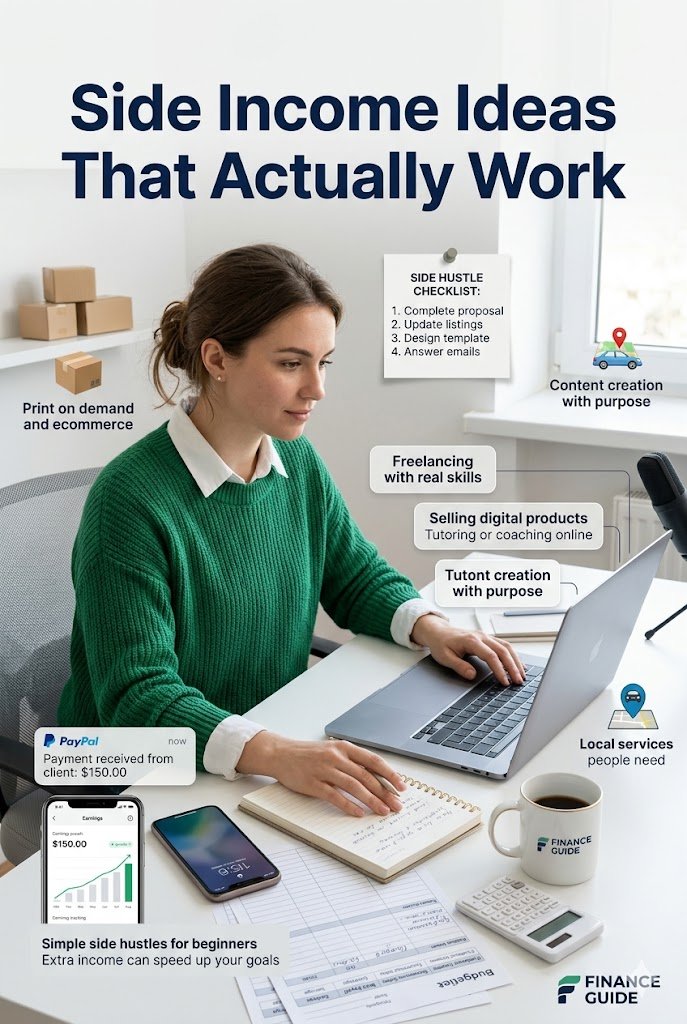
The ideal setup, once you have the runway to build it, is to start with active income to generate quick cash flow, then use that momentum to invest time into a more passive stream. put extra income toward your emergency fund first
Side Income Ideas That Real People Are Using Right Now
Freelance Services on Upwork or Fiverr
If you have any professional skill — writing, graphic design, bookkeeping, video editing, social media management, data entry, web development — there is a market for it on platforms like Upwork and Fiverr. The barrier to entry is low. The competition is real, but so is the demand.
New freelancers on Upwork earn between $15 and $40 per hour in their first few months. Established profiles with strong reviews regularly command $75 to $150 per hour or more. A part-time freelance writer working 10 hours a week at $35 per hour earns roughly $1,500 a month.
Selling Digital Products on Etsy or Gumroad
Printables, resume templates, lesson plans, budget spreadsheets, Lightroom presets, social media graphics — these are created once and sold indefinitely. Etsy has over 95 million active buyers, and the digital product category has grown substantially in recent years. A well-positioned digital template shop can earn anywhere from a few hundred to several thousand dollars monthly once it has traction.
The trade-off is time up front. Building a shop with enough listings to generate consistent traffic takes several months of consistent effort.
Content Creation on YouTube
YouTube ad revenue through the YouTube Partner Program requires 1,000 subscribers and 4,000 hours of watch time to activate. That takes time. But channels that clear this threshold typically earn between $2 and $10 per 1,000 views through AdSense, depending on niche. A personal finance or technology channel earns toward the higher end. Entertainment channels typically earn less per view.
The creators earning real money on YouTube are not chasing viral moments — they’re publishing consistently in focused niches where advertisers pay well.
Tutoring and Online Teaching
Platforms like Tutor.com, Wyzant, and Varsity Tutors connect educators with students. Math, science, SAT prep, foreign languages, and music are consistently in high demand. Tutors typically earn between $20 and $80 per hour depending on subject and experience level.
For those with professional expertise rather than traditional teaching backgrounds, platforms like Teachable and Podia allow you to package that knowledge into an online course. Course income varies enormously — from nothing to thousands per month — but the economics are favorable once you have an audience.
Rental Income from Property or Things You Own
This ranges from renting a spare bedroom on Airbnb to listing your car on Turo when you’re not using it. The average Turo host in the United States earns between $500 and $1,000 per month per vehicle, according to Turo’s published host data. Airbnb earnings depend heavily on location and how well the listing is managed.
Both require genuine effort, strong communication with guests, and a tolerance for occasional headaches. But for people with underutilized assets, this can be one of the fastest paths to meaningful side income.
Bookkeeping and Virtual Assistant Work
These are two of the most overlooked high-value side income streams for non-technical people. Bookkeepers with QuickBooks or Xero experience earn $25 to $55 per hour doing work that many small business owners desperately need but can’t afford to hire full-time staff for.
Virtual assistants handle email management, calendar scheduling, research, customer service, and project coordination for busy entrepreneurs and executives. Pay ranges from $18 to $45 per hour depending on the complexity of tasks and platform used.
Step-by-Step: How to Pick the Right Side Income for You

Step 1: Audit What You Already Know
Write down every skill, tool, and piece of knowledge you have from your job, hobbies, and life experience. Most people significantly undersell what they know. If you manage spreadsheets at work, that’s a marketable skill. If you’ve renovated your own home, that’s a marketable skill. If you’re genuinely good at something that other people struggle with, there’s a market somewhere.
Step 2: Decide How Much Time You Realistically Have
Be brutally honest here. Most people overestimate their available time and underestimate how tired they are after a full workday. Start with 5 to 8 hours per week as a realistic commitment and build from there. Do not design a side income plan that requires 20 hours a week before it’s tested.
Step 3: Decide How Quickly You Need Income
If you need money within two to three weeks, focus on active service-based work. Tutoring, freelancing, task platforms like TaskRabbit, and delivery apps can generate income almost immediately. If you can afford to invest time without immediate returns, content creation and digital products have higher long-term potential.
Step 4: Run a Simple Viability Check
Before committing, spend 30 minutes researching whether your chosen idea has a real market. Search for the service or product on relevant platforms. Are there existing sellers making money? Are there buyers actively looking? Competition is actually a good sign — it confirms that demand exists.
Step 5: Start Embarrassingly Small
The biggest career move I see people fail to make is launching too polished and too late. Your first freelance profile does not need to be perfect. Your first digital product does not need to be comprehensive. Your first YouTube video will probably be awkward. That is completely acceptable. Progress requires a published starting point, not a perfect one.
Step 6: Treat It Like a Part-Time Job for 90 Days
Give any side income path a genuine 90-day commitment before judging it. Many people quit at the 30-day mark when results are predictably small. Almost every real earner describes a period of little to no progress before things started clicking.
use side income to fund retirement
Practical Examples With Realistic Earnings
| Side Income Type | Time to First Dollar | Realistic Monthly Earnings at 6 Months | Realistic Monthly Earnings at 18 Months |
|---|---|---|---|
| Freelance writing | 1 to 3 weeks | $300 to $800 | $1,200 to $4,000 |
| Upwork IT or design | 2 to 6 weeks | $600 to $1,500 | $2,000 to $5,000 |
| YouTube channel | 3 to 6 months | $50 to $200 | $400 to $2,500 |
| Etsy digital products | 4 to 10 weeks | $100 to $400 | $600 to $3,000 |
| Tutoring | 1 to 2 weeks | $400 to $1,000 | $800 to $2,500 |
| Turo car rental | 1 to 2 weeks | $300 to $700 | $500 to $1,200 |
| Online bookkeeping | 3 to 8 weeks | $500 to $1,200 | $1,500 to $4,000 |
These ranges reflect realistic outcomes, not best-case scenarios. They assume consistent effort without assuming supernatural luck or viral success. taxes on your side income
Mistakes That Keep People Stuck at Zero
Trying too many things at once. Starting a blog, a YouTube channel, an Etsy shop, and a freelance profile simultaneously guarantees that none of them get enough attention to grow. Pick one direction and give it your full side-hustle energy for at least three months before adding anything else.
Pricing based on fear rather than value. New freelancers chronically underprice their work to get clients, then resent the work when they realize they’re earning $8 an hour. Research market rates before setting your price. It’s far easier to attract clients at $30 per hour than most beginners believe.
Waiting for permission that isn’t coming. There is no certification required to start most side income streams. No one is going to tap you on the shoulder and say you’re ready. The freelancer who starts with imperfect skills and learns on the job almost always outperforms the one who keeps preparing indefinitely.
Spending money before making money. The number of people who spend $500 on a course about a side hustle before they’ve made a single dollar from that side hustle is genuinely staggering. Learn enough to start for free, then invest in education once you’re earning and can offset the cost.
Ignoring the tax side of side income. Any side income above $400 is subject to self-employment tax. Platforms like Upwork and Turo issue 1099 forms for earnings above $600. Setting aside 25 to 30% of every side income payment for taxes prevents a painful surprise in April.
Quitting after a slow first month. Almost every legitimate side income stream shows very slow growth in months one through three. That phase is not evidence that the idea doesn’t work. It’s the period where most competitors drop out, which is exactly when sticking around starts to pay off.
Best Tools and Platforms to Get Started
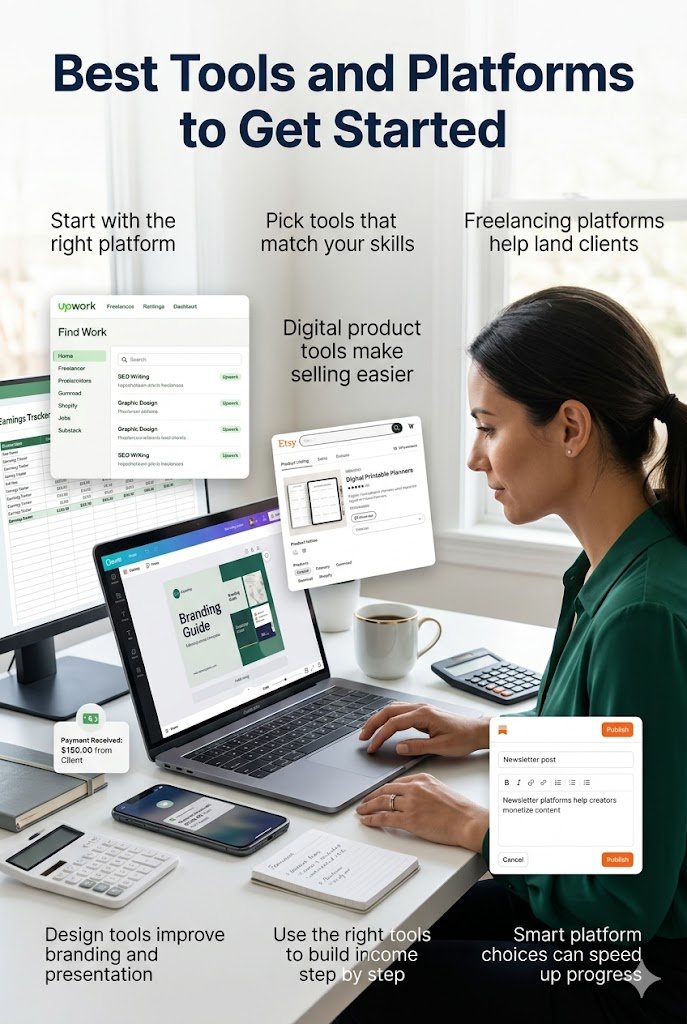
Upwork — The largest freelance marketplace in the United States. Strong for professional services like writing, design, development, marketing, and administrative work. Profile quality matters enormously; spend time building a specific, compelling profile before sending your first proposal.
Fiverr — Better for one-off project-based work where buyers browse services rather than posting jobs. Great for creative work, voice-over, translation, and specific technical deliverables.
Etsy — The go-to platform for digital and physical product sellers. The search and discovery algorithm rewards shops with multiple listings and positive reviews. Budget several months to build traction.
Gumroad — Simpler than Etsy and better suited for content creators selling digital products directly to their audience. No listing fees, just a revenue split on sales.
Teachable and Podia — Both are course creation platforms for packaging expertise into structured online learning. Teachable has a larger install base; Podia tends to be more beginner-friendly.
https://www.podia.com/podia-vs-teachable
Turo — The car-sharing marketplace where you list your personal vehicle for rent when you’re not using it. Turo handles insurance during trips, but read the coverage details carefully before listing.
Rover — For pet sitting and dog walking. The app matches you with local pet owners and handles scheduling and payments. Straightforward to start, popular in suburban and urban areas.
Wave Accounting — A free accounting tool for tracking side income and expenses. Particularly useful for preparing the numbers come tax season without spending money on software.
QuickBooks Self-Employed — Slightly more robust than Wave for freelancers with complex income streams. Automatically categorizes transactions, tracks mileage, and estimates quarterly tax payments.
Frequently Asked Questions
How much can I realistically earn from a side hustle in the first year?
For service-based work starting from scratch, a realistic first-year range for someone putting in 8 to 12 hours a week is $5,000 to $18,000. Content-based income like YouTube or blogging typically produces much less in year one but can significantly outpace service income in years two and three.
Do I need an LLC or business license to start a side hustle?
For most side hustles at the early stage, you do not need an LLC or formal business registration to start earning. You’ll file income on a Schedule C with your personal tax return. An LLC becomes worth considering once you’re earning consistently and want personal liability protection. A local CPA can advise on the timing.
What is the easiest side income to start with no money?
Freelance writing, virtual assistant work, and tutoring can all be started with zero upfront cost using free versions of platforms like Upwork, Wyzant, and LinkedIn. If you have a smartphone, content creation on YouTube or TikTok also costs nothing to begin.
Will a side hustle affect my full-time job?
As long as you’re doing side work on your own time and it doesn’t compete directly with your employer’s business, most side hustles fall well within acceptable boundaries. Review your employment contract for any non-compete or moonlighting clauses if you’re uncertain. Many contracts include language about conflicts of interest that’s worth checking.
How do I handle taxes on side income?
Side income above $400 must be reported to the IRS. If you expect to owe $1,000 or more in taxes from side work, you’re required to make quarterly estimated tax payments. The IRS Form 1040-ES and the IRS website’s estimated tax calculator walk through this. Many people use QuickBooks Self-Employed or a CPA to manage this.
Sources Used in This Article
- Upwork Work Without Limits Report 2024 — upwork.com
- Turo Host Earnings Data — turo.com (published host earnings statistics)
- Etsy Annual Report 2023 — investors.etsy.com
- YouTube Partner Program Requirements — support.google.com
- IRS Schedule C and Self-Employment Tax Guidelines — irs.gov
- Bankrate Side Hustle Survey 2024 — bankrate.com
- Freelancers Union and Upwork Freelancing in America Study — freelancersunion.org
Helpful Next Steps
The gap between reading about side income and actually earning from it is just one uncomfortable first step. Most people read ten articles and take zero action. The few who take imperfect action early are the ones who look back twelve months later with a second income stream that changed their options.
Here’s what to do in the next 48 hours:
- Write down three skills you have that other people pay for. Be specific — not “I’m good with computers” but “I know how to set up and manage Google Ads campaigns” or “I can transcribe audio accurately and quickly.”
- Pick one platform relevant to your skill and create a free profile today. Not this weekend. Today.
- Look at five existing profiles or listings from people offering the same service. Note their pricing, their positioning, and how they describe their experience. Use that as your benchmark.
- Set a calendar reminder for 90 days from now labeled “Evaluate Side Income Progress.” This creates a commitment to a fair trial period before drawing any conclusions.
- Open a separate savings account specifically for side income. Keeping it separate from your main account makes earnings feel real, tracks your progress clearly, and makes tax time considerably less chaotic.
Side income doesn’t require a business degree, a trust fund, or a miracle algorithm to work. It requires picking something real, starting before you feel ready, and showing up consistently when results are still small.
Try free tool savings goal calculator
Try free tool compound interest calculator
That’s the unglamorous truth behind every side income success story I’ve ever seen. Including my own.
This article is for informational and educational purposes only. Earnings mentioned are based on published platform data and real individual examples and do not represent guaranteed or typical results. Consult a financial or tax professional for advice tailored to your situation.

My name is Arshiyan Ahmed, and I write about personal finance because I’ve lived through the stress of financial uncertainty — and found my way out of it.
Over the past 7+ years, I’ve spent hundreds of hours studying budgeting systems, debt payoff strategies, and savings frameworks — not just in theory, but by applying them to real life. I’ve personally used the debt snowball method to eliminate credit card debt, built a 6-month emergency fund on a modest income, and helped friends and family create their first workable budgets.
I started Arshiyan Finance because I noticed one thing: most financial content online is either too complicated for beginners or too generic to be useful. I wanted to build a space where everyday people — whether you’re living paycheck to paycheck or just looking to manage money smarter — could find clear, actionable, and honest financial guidance without being sold something.
Everything I publish here is based on widely accepted financial principles, researched thoroughly, and written in plain language anyone can follow. The calculators, guides, and strategies on this site are the same tools I use and recommend to people I care about.
I’m not a licensed financial advisor, and nothing on this site is professional financial advice — but I do believe that access to good financial education can change lives. That’s why everything here is completely free.
When I’m not writing about money, I’m reading about it — because the more I learn, the better I can explain it to you.
Have a question or topic you’d like me to cover?